
An invitation to explore and seek wisdom for a mindful future. These resources have been helpful to my practice and I share them freely with you.
Apps to support your meditation practice.
“Creating an environment that nurtures children’s curiosity strengthens their motivation to learn. In developing language, just learning to name a ‘tree’ verbally and visually, does not create a sense of wonder and discovery. Allowing children to explore a tree physically and mentally, feeling the trunk, looking at the shape of the tree, the branches, the leaves, the smell, comparing one tree with another provides new information and understanding. Placing value on developing awareness as an important medium for learning the essential competencies for creating their own knowledge about the world.” — Mary Frances Reza, retired educator
Meditation teachers and centers:
- Susan and Bill Morgan
- Oren Jay Sofer
- Sensei Tetsudo Murphy
- Tara Brach
- Cathy Black – Lumos Center
- Compasionate Ocean Sangha
- Vallecitos Mountain Retreat Center, New Mexico
- Mark Coleman – Awake in the Wild
- Mountain Cloud Zen Center – Santa Fe, NM
- Great Mountain Zen Center – Berthoud, CO
- Sharon Salzberg
- Jack Kornfield
- Sage Institute for Creativity and Consciousness is where I earned meditation teacher credentials.
Mindfulness and Meditation programs for schools, children and families
- Check out our YouTube channel for guided meditations for all age groups
- Mindful Frontiers has a program entitled Recipe for Wellness, a holistic program of wellness and social-emotional learning. The “recipes” contribute to youth and community empowerment through social-emotional intelligence, creative curiosity, body, mind, and spiritual health. Reach out with any questions.
- Recipe for Wellness: Families Meditate Together encourages families to bring mindfulness into their homes and to engage in ongoing meditation practice together. This project reaches families in their homes through virtual classes where meditation instruction is shared between parents and children. Please inquire about our classes.
- Recipe for Wellness: Mindfulness in the Classroom is a 6-week series of mindfulness lessons for elementary and middle school students. The lessons teach mindful concentration and awareness through the lens of mindful breathing, mindfulness of sound, emotional awareness, body scanning, and mindful eating. Reach out with questions or contacts of schools/teachers interested in bringing this program to their classrooms.

“Making meditation accessible and ‘normalizing’ meditation and using it as a daily routine would be so beneficial for families and children as a daily routine. In these hectic times, learning how to just be and find calmness is an important tool in your self-care toolkit.” — Nina Silfverberg; parent and Public Programs Manager at Twirl Taos
Mindfulschools.org
- Videos page at Mindfulschools.org
- Explanation of how to incorporate mindfulness into a school’s EQ/SEL check-in routine.
- Mindfulness in Education video
- Research around mindfulness
- Explanation of the approach of using mindfulness in schools
- Mindful Schools organization and history
Additional meditation resources and links
- Arthur Zajonc – Mind and Life Institute
- Parker J Palmer – author – Center for Courage and Renewal
- Rio Grande Mindfulness Institute and Mountain Cloud Zen Center in Santa Fe, NM. Heart of Teaching workshops, dharma talks, retreats, etc.
- People I’ve spoken with or know: Erin Woo (Mindfulness in Schools Program Development) Lynn Koerbel (Assistant Director, MBSR Teacher Education & Curricula Development) at Brown University Mindfulness Center
- “Say What You Mean” a mindful approach to nonviolent communication by Oren Jay Sofer is a fantastic read that I acquired after taking his Mindful Communication course at MindfulSchools.
- Christopher Willard’s video on Mindfulness and teenage stress: Growing Up Stressed I showed this video to my English Language Arts classes and then students reflected and wrote about what they learned.
Books on Mindfulness and Meditation:

The Meditative Mind by Daniel Goleman with a foreword by Ram Dass. This section on mindfulness caught my eye. Although the writing style is quite dry, the information on using mindfulness anchors toward meditation insight is worthwhile reading. (page 22)
Kinds of Mindfulness
“There are four kinds of mindfulness, identical in function but different in focus. Mindfulness can focus on the body, on feelings, on the mind, or on mind-objects. Any one of these serves as a fixed point for bare attention to the stream of consciousness. In mindfulness of the body, the meditator attends to each moment of his bodily activity, such as his posture and the movements of his limbs. The meditator notes his body’s motion and position regardless of what he does. The aims of his act are disregarded; the focus is on the bodily act itself. In mindfulness of feeling, the meditator focuses on his internal sensations, disregarding whether they are pleasant or unpleasant. He simply notes all his internal feelings as they come to his attention. Some feelings are the first reaction to sensory messages, some are physical feelings accompanying psychological states, [and] some are by-products of biological processes. Whatever the source, the feeling itself is registered.
In mindfulness of mental states, the meditator focuses on each state regarding awareness. Whatever mood, mode of thought, or psychological state presents itself, he simply registers it as such. If, for example, there is anger at a disturbing noise, he simply notes ‘anger’ at that moment. The fourth technique, mindfulness of mind-objects, is virtually the same as the one just described, save for the level at which the mind’s workings are observed. Rather than noting the quality of mental states as they arise, the meditator notes the attentional objects that occupy those states, for example, ‘disturbing noise.’ As each thought arises, the meditator notes it in terms of a detailed schema for classifying mental content. The broadest category on this list labels all thoughts as hindrances to or helping toward enlightenment.
Any of these mindfulness techniques will break through the illusions of continuity and reasonableness that sustain our mental lives. In mindfulness, the meditator begins to witness the random units of mind stuff from which his reality is built. From these observations emerge a series of realizations about the nature of the mind. With these realizations, mindfulness matures into insight.

Buddha in the Classroom by Donna Quesada

Say What You Mean: a mindful approach to nonviolent communication by Oren Jay Sofer

Self-Compassion for Parents by Susan M. Pollak
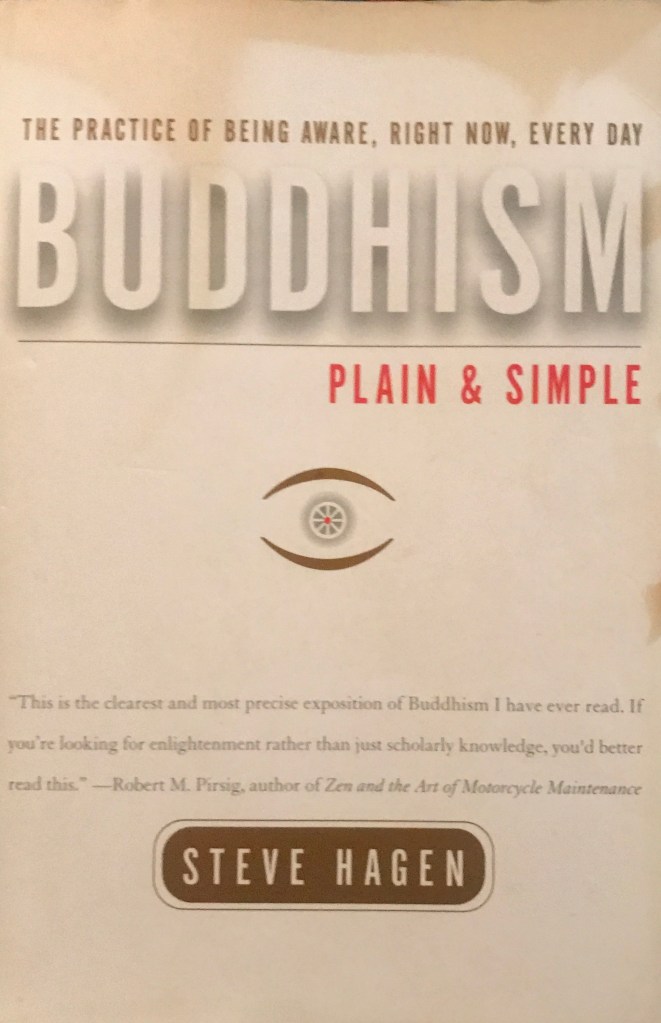
Buddhism Plain & Simple by Steve Hagen

Everyday Zen by Charlotte Joko Beck

Awake in the Wild: Mindfulness in Nature as a Path of Self-Discovery by Mark Coleman

Dāna: The Practice of Giving
“Dāna (pronounced ‘daa-nuh’) is the Pāli word for giving. Dāna is the first perfection of the heart (pāramī) and the foundation of Buddhist practice based on the understanding that giving opens the heart, creates connections to others, and teaches letting go.
According to the Buddha, generosity and sharing of resources are a central pillar of spiritual life and the foundation of wholesome kamma—action that bears fruit in our lives and the lives of others. Dating back to the Buddha and the first monastic practitioners, those who preserve and offer the teachings have always lived in interdependence with the community around them. Buddhist monks and nuns rely entirely on the generosity of lay people for support in continuing their teaching and spiritual life.
The practice of dāna has kept the Buddhist tradition alive for more than 2,600 years, throughout which committed supporters have generously established networks of monasteries and retreat centers, supporting millions of teachers and practitioners. The dāna system is an ancient form of gift economy based on open-handedness and trust in community.”


 Mindful Frontiers LLC
You must be logged in to post a comment.