Close Cousins on the Path of Well-being.
As a meditation guide and coach, I often hear comments such as, “I can’t meditate because I can’t sit still,” or “I can’t stop my mind from thinking.” Thich Nhat Hanh, a Vietnamese meditation master and founder of Plum Village, believed that “people should learn to be, rather than just do, and that doing nothing can bring about a quality of being that is very important.” We fear “doing nothing” because we have been trained that our worth is in what we accomplish. Furthermore, the ego identifies itself in mind activity. Meditation helps us be in the moment, mindful of what’s here, and now. Through “doing nothing”, we may even find inspiration for our next project.
Another comment I hear is, “I prefer yoga to meditation because I need to move my body.” Indeed, all beings enjoy movement and we need exercise to keep our bodies healthy. Yoga is a movement practice that includes meditation. There are eight limbs of yoga of which three are close cousins to meditation: Pranayama: Breathing techniques that regulate breathing and calm the mind, Dharana: The concentration of the mind and Dhyana: Meditative absorption where the mind is completely focused on an object of meditation. Meditation includes breathing, calming the body, and focusing the mind on an object of attention.
Meditation helps us be in the moment, mindful of what’s here, and now.
A blog post from Arohan Yoga further explains the connection: “Yoga and meditation are deeply intertwined. Yoga postures can prepare the body for meditation by releasing tension and improving focus. The relationship between yoga and meditation is like a dance between two partners, each complementing and enhancing the other. Together, they create a harmonious path towards overall well-being, helping us to find balance and tranquility in our lives.” The main benefit of meditation is to calm the mind and body so if you can do yoga, you can meditate.
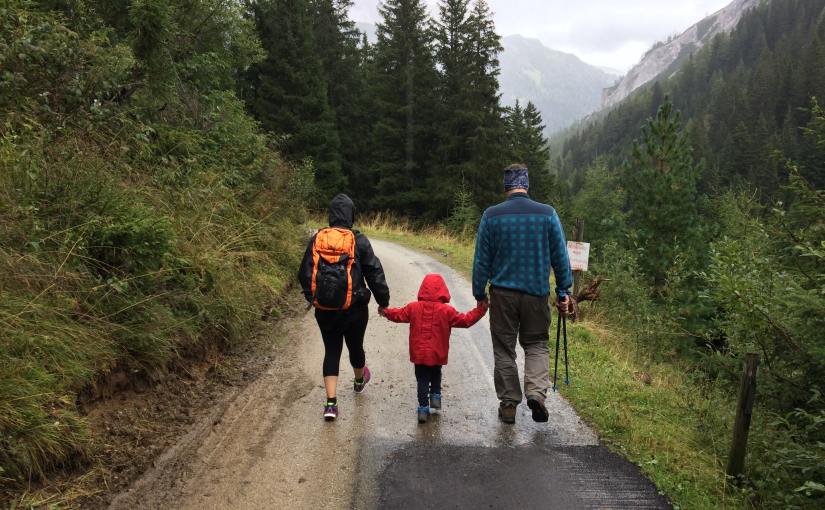
This month’s family practice involves combining meditation and walking. Thich Nhat Hanh emphasized the practice of mindful walking as a profound way to deepen our connection with our body and the earth. While on my daily walk recently, I explored various ways to combine mind-body connection with walking meditation. Although zen-style walking meditation involves linking the breath to our steps intentionally, I believe we can use simple mantras accompanying the rhythm of our steps to bring meditation into a daily movement routine.
Walking meditation mantras
When you and/or your family are on a walk, choose a mantra and repeat it as long as you can keep your attention on the words. The rhythm can be slow or brisk, following the pace of your steps. When the mind gets distracted or bored, choose another mantra and continue walking. The eyes are focused straight ahead, and slightly down, on the path forward. From time to time, we stop, gaze upward, and appreciate the view before returning to our walking meditation.
- Left foot, left foot …
- Right toe, right toe …
- I move with ease, I move with ease …
- May I walk in peace …
- Grounded in the earth …
- Chakra mantra: Lam, Vam, Ram, Yam, Ham, Om …
During your next exercise walk or hike, explore blending meditation with movement for a full body-mind experience!
Anne-Marie Emanuelli is the founder and Creative Director at Mindful Frontiers LLC. Mindful Frontiers LLC is a Benefit Corporation (BCorp) committed to community wellness by providing, schools and organizations mindfulness meditation tools that nurture positive social-emotional growth. With over two decades of meditation experience, Anne-Marie offers coaching for children, families, individuals, groups, and classrooms. She is a certified meditation leader and a certified labyrinth facilitator. Featured practices can be found on the Welcoming a Mindful Future podcast and Insight Timer app. Our website is MindfulFrontiers.net.

 Mindful Frontiers LLC