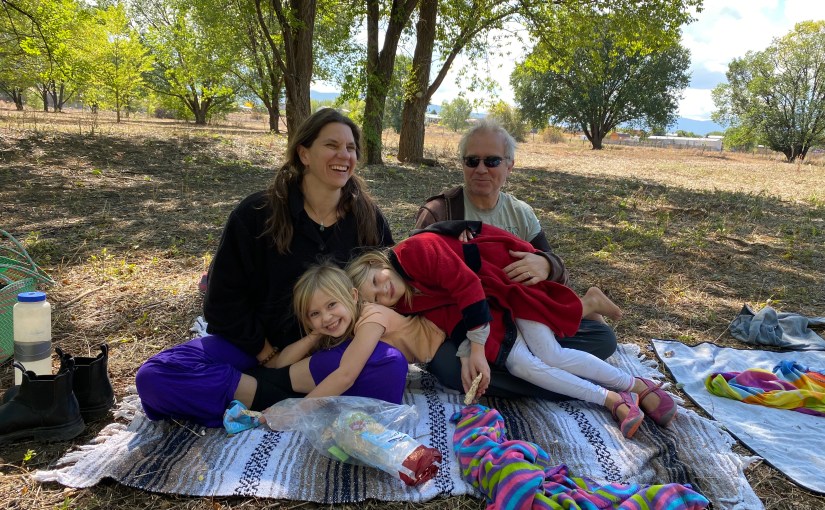
Welcoming a Mindful New Year: How to Bring Meditation into Your Family’s Routine.

It’s a new year according to the construct of our human-made 12-month calendar. However, it is not just a new wall or desk calendar. “A new year starts when Earth has made one orbit around the Sun. This takes roughly 365 days, so every new year on the last day of December, we are at the same location around the Sun as last year.” (Astronomicca.com) 

As we get ready to start a new year, many people will resolve to make changes in their life. Most New Year’s resolutions start with honest determination and end within a few weeks or months with lassitude. In this month’s column, I’d like to explain how to bring mindfulness and meditation into your family’s daily routine and make it stick. It isn’t difficult and like any change, it takes willingness, vulnerability, and practice. Meditation is called a “practice” for good reason: it takes repetition, just like an exercise routine, to make it part of our schedule. So how can a family bring mindfulness meditation into an already-busy schedule? It’s as simple as one breath, one present moment at a time, and practice.

The reasons for bringing mindfulness meditation (also called vipassana meditation) into your family’s life are well researched and proven. 

  • Families learn how present-moment mindfulness awareness can bring relaxation and social-emotional wellbeing into their home.
  • Children learn that they aren’t judged by their thoughts, sensations, and feelings.
  • Mindfulness is a way to feel good about yourself, just as we are in this moment, and it settles the nervous system in the process.
  • Parents model what it looks like to be confident yet relaxed; to be happy and at ease, while accepting that life is never perfect.
  • Families build strong bonds through a shared activity; the time spent together is an investment in compassionate relationship-building.

Five ways to bring mindfulness into your family’s daily routine:

  • When the family is gathered at the dinner table, mindfulness can be incorporated in the first few minutes before eating. Whether you say a prayer or express gratitude for the food being shared, mindfulness can be as simple as a couple of minutes of noticing the body, the food, the colors, and acknowledging all that came together for the food to be available at this moment. In my family, we say a prayer and when it’s my turn, I start by having everyone feel their feet on the floor, head reaching the sky, sitting area on the chair, and what is felt at the heart center. Then, we thank all life forms for the food on the table and all those who had a part in bringing the meal to the table.
  • When the family is driving to and from school or another activity, we can notice sounds, sights, feelings internally and externally in our environment. Electronic devices are put down for a short period of present-moment mindfulness. 
  • When picking up children from school, parents generally ask, “How was school today?” Often, the answer is a basic, “Fine”. We can encourage more discussion by asking the question, “What is something that happened today that felt good, brought joy, made you laugh?” Then, we can ask, “How did that feel in your body?” It may be harder for younger children to tap into this and they will learn how with practice.
  • During an active time of the day, we can do some mindful movement. Dancing, yoga, walking, and just jumping around can be an opportunity for mindfulness. Encouraging children to notice what their body is doing, how it feels in the different limbs to move, what sounds are generated by the activity, and if this is happening outside, noticing nature is a great mindful activity.
  • Before settling in for the night, the parent can lead a body scan to bring mindful relaxation to the bedtime routine. Bringing attention to each part of the body, starting from the feet or the head is very relaxing. Imagining a butterfly landing on each part of the body can add visualization to the body scan.

I suggest experimenting with one of these for one week at a time and then discussing with your children which ones they enjoy. Then, rotate between these mindfulness activities from time to time to keep the experience fresh. Children (and parents) like having a predictable routine and yet can get bored with the same thing after a while. Although meditation is about practice, our minds need variety, too.

published January 13, 2022 in The Taos News

Small hearts can hold lots of gratitude

Mindful eating practice for families

Gratitude is the theme for November with Thanksgiving and Chanukah holidays coming up. Practicing gratitude is an extremely important skill because it brings joy and appreciation to our life through the power of the heart. It’s mental health and a daily attitude that helps us connect with that which brings us joy. Mindful eating is a perfect mindfulness activity for the month of November and one that can be practiced any time that food is available.

“Piglet noticed that even though he had a very small heart, it could hold a rather large amount of Gratitude.” 

– A. A. Milne, Winnie-the-Pooh

Appreciation through kindness

Gratitude is defined as “readiness to show appreciation for and to return kindness” (Webster online dictionary). What’s important in this definition is the willingness to appreciate and to incorporate kindness. We may be appreciative of what we have, what we don’t have, how we feel, or how we are experiencing life and we relate to this with kindness. Being grateful helps us alleviate suffering by bringing our awareness to the positive instead of the negative. It is also a way to practice open-hearted kindness towards others and ourselves.

Daily gratitude practices can be a way to focus on the positive

During this global pandemic, mental health has been affected by stress, worry, and a general malaise that we are all experiencing. As a long-time meditation practitioner and teacher, gratitude practice is a staple in my daily routine. I keep a gratitude journal in which I write what I’m grateful for either at the start or end of the day. I find that practicing gratitude brings present-moment awareness and a way to wind down the mind.

Parenting is challenging so gratitude is a family activity that reaps benefits for everyone.

As a parent to a teenager, I try to model being grateful to remind my family of the benefits of this practice. We often ask each other what we are grateful for at the dinner table or before retiring for the night. We say a gratitude prayer before we eat, thanking all that had a part in the meal. My daughter and husband are getting better at training the mind to focus more on the positive aspects of the day. My family has learned about the power of attraction and when we think positive thoughts, we attract more gratitude and positivity and feelings of well-being. It doesn’t take a lot of time to practice this and can be as simple as pausing, taking three long deep breaths, reflecting on the present moment, and then choosing something or someone for which to be grateful. The practice does take repetition to become routine and it is well worth the effort.  That’s why it is called “a practice.”

Some aspects of life for which we can be grateful:

  • A place to live
  • Work that sustains
  • Food that nourishes the body
  • Feelings that bring awareness to the self
  • Pets who bring unconditional love
  • Family with whom we can communicate 
  • A mind that can choose what to think about
  • A heart that can be open to compassion and empathy
  • A body that is healthy and able to move freely
  • Open spaces in which to exercise
  • Talents we can share with others
  • The present moment in which reality is positive

This gratitude practice is inspired by Thank the Farmer from Mindful Games by Susan Kaiser Greenland and is a mindful eating practice that is perfect for the holiday season. 

Choose a person to “lead” the meditation practice. This person will read the instructions as well as participate. This is a slow practice so make sure to take your time.

  1. Start by picking one item of food. A raisin is commonly used. I have also used popcorn or a piece of cookie. It must be small as this is not a meal or even a snack. It is a mindfulness practice and using our 5 senses, we will explore the story of this food.
  2. With the food in your fingers, notice what it feels like. Smooth, rough, squishy, hard, etc.
  3. With your eyes, notice what it looks like. A cloud, a shape, a bumpy glob, etc.
  4. With your nose, notice what it smells like. Sweet, strong, weird, etc.
  5. With your ears and fingers, notice what it sounds like. Crackles, squeaky, etc.
  6. With your mind, consider where this food grew. A farm, a forest, a garden, etc.
  7. Consider who picked this food? A person, a machine, a family, etc.
  8. Ask yourself how it gets to the store? A truck, a car, a person brings it, etc.
  9. How did it get from the store to your home? Your parent, friend, sibling, etc.
  10. Now, we take a moment to feel gratitude for having this food to eat. Say, “thank you” to everyone who had a part in growing and bringing the food to your home. The farmer, the picker, the truck driver, etc.
  11. Now we put the food on our tongue and notice what it tastes like, before actually eating it. Don’t chew yet! Just let it sit there momentarily.
  12. Finally, we get to chew it… what does it taste like now, after all that mindful awareness? 
  13. Have you thought about your food this way before? Do you think it tastes differently now?

Thanks for trying out this practice. I’d love to hear what your family experienced. Email me at mindfulfrontiers@gmail.com.

Anne-Marie Emanuelli is the founder and Creative Director of Mindful Frontiers LLC, an education-based mindfulness meditation center in northern New Mexico offering classes, workshops, and coaching to children, families, and individuals of all ages and meditation experience. Anne-Marie’s credentials are from Mindful Schools and Sage Institute for Creativity and Consciousness as well as an 8-week MBSR course. She is a retired NM level 3 licensed classroom teacher and has taught mindfulness to students since 2016.

For more information on Mindful Frontiers and meditation, see our website at MindfulFrontiers.net.

Moods Change Like the Weather: A gratitude practice for families

(A similar version was published in The Taos News, October 14, 2021)

The human brain seems to have a natural tendency to remember negative experiences more than positive interactions. Psychologists refer to this as negativity bias. “Our brains are wired to scout for the bad stuff and fixate on the threat”, says Rick Hanson, Ph.D., a psychologist, Senior Fellow of UC Berkeley’s Greater Good Science Center.

Our brain is by function and development a very “old” organ. The part of our brain that is the least developed is the amygdala and is responsible for the fight, flight, freeze reaction to emotional experiences. This inner brain was very important when we were hunter-gatherers because we needed to be ever vigilant of threats to our survival. 

Gratitude is a powerful meditation tool for dealing with our changing moods which I describe as our internal weather patterns.

— Anne-Marie Emanuelli

As humans have evolved, this part of the brain has remained essentially undeveloped. On the other hand, the largest part of the brain, the cerebral cortex, has evolved and continues to develop. This frontal area is responsible for many higher-order functions such as perception, sensation, memory, and interpretation. Meditation and mindfulness stimulate this area of the brain as well as the parasympathetic nervous system that originates in the brainstem and is responsible for relaxation. 

Gratitude is a powerful meditation tool for dealing with our changing moods which I describe as our internal weather patterns. When teaching young children about emotions, I encourage describing them as weather such as stormy, cloudy, rainy, and sunny. Young children understand how the weather feels much easier than describing their emotional state. They know “mad, glad & sad” and it’s more challenging for them to describe how they are feeling with more subtle and specific emotional words. Each child perceives their mood differently so “cloudy” for one child may mean feeling introspective while for another could mean lonely. It doesn’t really matter. The point is that by labeling emotions we move the experience out of the amygdala to the frontal cortex which makes it possible for us to bring mindfulness to the emotion. When we practice gratitude we feel kindness and appreciation for our life experiences. Mindfulness can help us notice thoughts and sensations in the present moment.

The more one welcomes gratitude, the more comfortable one can be with feeling emotions. With practice, the change of moods will settle as the heart fills with kindness. The following practice is intended to help children notice moods & emotions, to bring gratitude and awareness to them, and feel a lifting of internal weather patterns.

Family Meditation Practice: This practice uses gratitude and mindfulness to notice and allow emotions to transform.

First, find a comfortable place to sit together as a family. A circle is a nice configuration that generates unity and attention. Choose a person to “lead” the meditation practice. This person will read the instructions as well as participate.
1. Once everyone is comfortable and still, start with some quiet breathing. Can you feel the rhythm of your breath as it flows in and out of the body?
2. While being aware of your breath, bring attention to your heart center. If you’d like, you can put your hands on your heart. Then, notice how you are feeling inside your body.
3. Each person takes a turn sharing how they are feeling today. What kind of weather describes how that feels? Cloudy, sunny, rainy, stormy, windy, etc. Try to visualize the weather swishing through your body. Everyone gets to share what they are feeling and what kind of weather it is.
4. Now everyone gets quiet again and notices their breathing. After a few calming breaths, imagine/visualize something in your heart like a person, a flower, a stuffed animal, or a special place that brings you joy. Continue breathing in and out while you silently feel gratitude for what you have in your heart.  You can say, “I love you” to that image.
5. Continue visualizing the gratitude image while also noticing the weather going around your body.  The weather is swishing around with the gratitude image in the center of the heart.As we continue feeling the “weather pattern” and visualizing the gratitude image, notice how they merge together into something else, like a sunny day or a quiet, cloudy day. Stay curious about what is happening inside. 
6. When it’s time to close the meditation circle, have everyone describe what they are feeling now. Maybe a word, weather, or a picture can be used. Then, everyone takes a big, deep breath together.
Thank you for trying this meditation.

Bio/Attribution:

Anne-Marie Emanuelli is the founder and Creative Director of Mindful Frontiers LLC, an education-based mindfulness meditation center in northern New Mexico offering classes, workshops, and coaching to children, families, and individuals of all ages and meditation experience. Anne-Marie’s credentials are from Mindful Schools and Sage Institute for Creativity and Consciousness as well as an 8-week MBSR course. She is a retired NM level 3 licensed classroom teacher and has taught mindfulness to students since 2016.
For more information on Mindful Frontiers and meditation, see our website at MindfulFrontiers.net

Families Meditate Together Column

The monthly newspaper column in The Taos News publishes on the second Thursday of the month. The purpose of this Families Meditate Together column is to encourage families to explore the benefits of bringing mindfulness and meditation into their daily routine. Each column will focus on a topic of teaching, followed by a practice, which can be done at home or during a regular day of activities.


Welcoming a Mindful New Year: Bringing Meditation into Your Family’s Routine.

published January 13, 2022

https://www.taosnews.com/opinion/columns/welcoming-a-mindful-year/article_c5c282f9-fc14-5ca3-8d4c-94d91c6312bf.html


Meditation brings joy and kindness to family celebrations

Published December 9, 2021

https://www.taosnews.com/opinion/columns/meditation-brings-joy-and-kindness-to-family-celebrations/article_a259a53c-a69e-553b-83f6-bd74c434ba38.html


Small hearts can hold lots of gratitude: Mindful eating practice for families

published November 11, 2021

https://www.taosnews.com/opinion/columns/small-hearts-can-hold-lots-of-gratitude/article_3ae29e8f-271a-522f-8ab0-fde713b1ddf9.html


Moods change like the weather: A gratitude practice for families

published October 14, 2021

https://www.taosnews.com/opinion/columns/moods-change-like-the-weather/article_1cba8c2f-a2bb-5e21-80fe-d7d8a4ff4e58.html


Slowly, slowly: Movement meditation brings mindfulness into daily activities

published September 9, 2021

https://www.taosnews.com/opinion/columns/slowly-slowly-movement-meditation-brings-mindfulness-into-daily-activities/article_d912c87a-1271-11ec-8302-033fdf327ce0.html


Make mindfulness part of your child’s daily routine

published August 19, 2021

https://www.taosnews.com/opinion/columns/make-mindfulness-part-of-your-childs-daily-routine/article_dbb38efb-81e2-549d-b84c-9991a67225ff.html