Impermanence and the Cycle of Life:

Meditating on the Change of Seasons

I subscribe to a variety of meditation magazines and online blogs, always curious to deepen my understanding of meditation. Recently, I read an article titled “The Joy and Dread of Autumn” by Jay Michaelson that spoke directly to my heart. Michaelson writes, “At this time each autumn, as leaves begin to fall in earnest … I actually feel a desire to somehow paste them back onto the trees.” Reading this, I thought to myself, “Yeah, that’s usually how I feel, but not this year.”

After an exceptionally hot and uncomfortable summer, I find myself more willing than usual to welcome the change of seasons. Recently, our area received an extraordinary amount of moisture, and the gardens are rejoicing with late blooms. This year, the cooler temperatures and changing season feel less like something I need to resist.

Perhaps this is another lesson in impermanence. Not only do the seasons change, but our feelings about change can too. Michaelson writes, “Even if the autumn leaves are riotously beautiful, the bare branches of February are bleak and dour.” I still grieve the passing of the green season into what I consider the nostalgic brown season. There is something melancholy about watching the leaves turn, fall to the ground and eventually disappear. But this year, alongside that sadness, I feel a sense of relief and gratitude.

If we look into the first Dharma Seal, impermanence, we see that it doesn’t just mean that everything changes. By looking into the nature of things, we can see that nothing remains the same for even two consecutive moments. (Thich Nhat Hanh)

In Buddhist teachings, impermanence is the understanding that everything is continually changing. Nothing stays exactly as it is. Leaves change color and fall to the ground. Flowers bloom and fade. We grow older. Our bodies change. Relationships evolve. Even our emotions are constantly shifting.

We may understand this intellectually, but accepting it emotionally can be much harder. When I notice myself longing for summer, I can feel it in my body as churning in my stomach or heaviness in my heart. Instead of trying to talk myself out of these feelings, I can simply notice them. There is sadness here. There is resistance. There is a desire for things to stay the way they were.

Mindfulness gives us a way to be present with these feelings without needing to change them.

But mindfulness also invites us to notice what else is true. This year, I can feel gratitude for the cooler weather. I can appreciate the rain and the renewed moisture in the earth. I can enjoy the changing colors without wishing them away. After this summer’s heat, the coming of autumn feels like a welcome reprieve.

Perhaps equanimity is also what the changing seasons ask of us: to stay present at the threshold, where one thing is fading and another is arriving. I can feel the ache of what’s being lost without overlooking the quiet relief of what is coming. This can be a wonderful practice for families, too. The changing season offers a simple way for children to explore their own responses to impermanence.
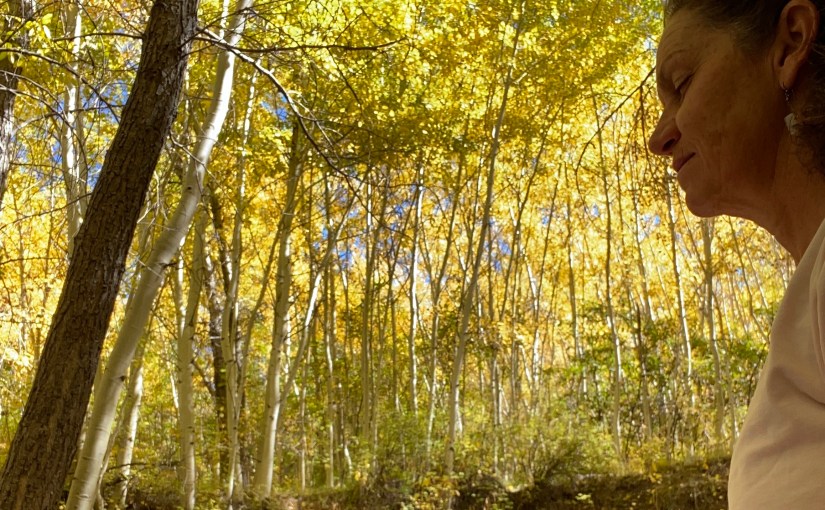
Find a quiet place outdoors, perhaps on a hike, in a backyard or in a park. Sit together among the trees and begin by noticing where your bodies touch the earth. Take a few slow breaths and then simply ask yourself: How do I feel about seasonal change? There is no right answer, and no need to say anything aloud. From there, let the senses guide the practice. What colors do you see in the leaves, branches and plants? What is the temperature of the air? Can you smell the earth, fallen leaves or evergreen trees? What sounds do you hear? Perhaps birds, squirrels, wind moving through the trees or leaves rustling across the ground. Just notice what is here in the moment. We are experiencing change rather than merely thinking about it. The leaves are changing. The air is cooling. The landscape is becoming something different. We are changing.

Of course, I don’t expect to have suddenly become an autumn aficionado. I suspect I will always have a preference for the green season and feel a little nostalgic when it turns to the brown season. But perhaps this year I am honing my understanding of impermanence and equanimity. I can miss summer and still welcome fall. I can mourn what is passing while appreciating what is arriving. Maybe that is the wisdom of the seasons: nothing stays the same, and nothing needs to. The leaves will fall. Winter will come. Spring will return. 

For now, we can breathe in the cooler air, enjoy the changing landscape and be grateful for this moment in the cycle of life. Just as the seasons move from one to another, our own lives continually ask us to adapt, release and begin again. Mindfulness can help us meet these transitions with greater awareness and compassion, without holding too tightly to what is passing or rushing toward what comes next. If you’d like to explore impermanence and equanimity through meditation, Mindful Frontiers offers meditation guidance customized to your specific needs, creating space to pause, reconnect and become more present for whatever season of life you are experiencing.

************************************

Anne-Marie Emanuelli is a mindfulness meditation teacher and founder of Mindful Frontiers LLC. She leads community meditation groups in Taos on Mondays 10-11am at Taos Enchanted Village and Wednesdays 12-1pm at the Taos Public Library. Mindful Frontiers offers meditation & mindfulness classes, guided practices, workshops, and customized programs that support emotional well-being and resilience. Learn more at MindfulFrontiers.net.

Understanding Fascism Through a Buddhist Lens

Or

“How do I get through the heartache of all the cruelty?”

You experience freedom when you recognize that objects of hope and objects of fear are subjective phenomena that are not part of objective reality. (Andy Karr)

Recently, I have been challenged by how to navigate the current political situation in the US, given that I am also a trained meditation leader. I should be able to stay grounded during this challenging time, yet some days I get swept up in the frenzy churning across the country. Some days I feel overwhelmed by the cruelty, the corruption, the manipulation, and hypocrisy of what seems to be a fascist overthrow of our democratic government. There is so much blatant disregard of the US Constitution and outright corruption and illegal maneuvers.

I grew up devoutly Catholic and felt close to Jesus’ teachings of love, compassion, and acceptance. I also feel very close to earth-based spirituality, and I find solace and balance in nature. Native American spirituality is a perspective that helps me find meaning and belonging in an ever-changing world. Certified as a meditation leader, I have studied Buddhism, and its philosophy has helped me, in times of uncertainty, to hold the suffering of the world with equanimity and compassion.

So, I decided to research the Buddhist perspective on why fascism is rising and taking form now. This writing is from research and a stream-of-consciousness sharing to help me get clear and settle into some kind of acceptance. My heart needs to ground into the present moment, and my mind needs to understand. Here’s what I have learned. (This is long and heady. Hope you’ll stay with the flow and allow mind and heart to collaborate.

From a Buddhist perspective, the question isn’t only “Why is fascism appearing now?” but also “How is it that we are perceiving it now?” Buddhism treats both the phenomenon and its perception as products of conditions coming together.

A hard but central Buddhist insight would remind us that the seeds of fascism exist wherever fear, clinging, and ignorance exist. This insight comes from the concept of dependent origination, which teaches that nothing arises from nowhere. All phenomena occur (or arise) due to causes and conditions (pratītyasamutpāda). Fascistic tendencies aren’t sudden anomalies; they emerge when certain conditions converge:

  • fear and insecurity (economic, cultural, ecological)
  • perceived loss of identity or status
  • unresolved historical trauma (slavery, genocide, inequality)
  • systems that reward domination over compassion

From this perspective, what we’re seeing in the U.S. is a predictable outcome of long-standing societal causes that were never fully addressed. Collective clinging and the illusion of a fixed self help to understand the concepts of suffering, clinging to identity, certainty, power, and narratives of “us vs. them.” A society grasping for solidity in a world that feels impermanent and out of control leads to disregulation. Buddhism would say, “When impermanence is rejected, fear hardens into aggression. Fascism feeds directly on these ideas:

  • clinging to a rigid national identity
  • clinging to race, religion, or “tradition” as fixed and threatened
  • clinging to authority as a source of safety

Furthermore, in Buddhism, ignorance (Avidyā) as a social force isn’t stupidity—it’s misunderstanding the nature of reality. When ignorance dominates, compassion shrinks, and systems rooted in domination appear reasonable, even necessary. Fascism, through this lens, is ignorance made structural. Ignorance shows up socially as:

  • mistaking narratives for truth
  • confusing power with strength
  • believing suffering can be ended by eliminating “others.”

So, a question arises, “Why are we perceiving/experiencing a fascist takeover now in the U.S.?” Buddhism explains that our awareness is conditioned, and it is becoming visible because the conditions for seeing it are now present. What was once normalized societal behavior is becoming visible as suffering. It may be that our collective consciousness is evolving, and we no longer accept what was once considered normal. There has been a steady progression of consciousness throughout history, but the fascist patterns are now more obvious because:

  • information flows more freely (even if distorted)
  • marginalized voices are harder to silence
  • crises (pandemic, climate, inequality) expose the ethical core of systems
  • Denial is less sustainable

Buddhism doesn’t respond to social suffering with despair or moral panic. It emphasizes right view — seeing clearly without hatred and with mindfulness; being aware of the present moment and bringing a deep focus to it without reactivity. Right view and right understanding include:

  • Naming harm without demonizing people
  • Resisting dehumanization in all directions
  • Understanding that those drawn to authoritarianism are also acting from fear and delusion

In summary, from a Buddhist perspective, fascism in the U.S. appears now because:

  • The causes have been ripening for a long time
  • Instability intensifies clinging
  • Ignorance becomes politically organized
  • Awareness/collective consciousness has matured enough for some to see it clearly

The question Buddhism leaves us with isn’t only “How and why did we get here?” but, more importantly, “Can we respond without perpetuating the same fear and delusion we’re trying to oppose?” Understanding the current political situation through a Buddhist lens doesn’t weaken the need for resistance. Instead, it helps ground the commitment to resist in wisdom rather than rage. That which sees the growth of fascism in the U.S. and that which resists and protests it are actually the same. By letting go of clinging and aversion and replacing them with compassion and love, may we engage in protests from a shared desire to find harmony in our world. There’s a shared goal: to live in harmony and without fear.

Bodhicharyavatara – The way of the Bodhisattva – by the great Master Shantideva.

May all beings everywhere

afflicted with suffering of body and mind

achieve an ocean of happiness and joy

By virtue of my merits

That no living creature suffers,

Commit evil and never get sick

Let no one fear or be belittled

May the mind not be weighed down by depression

The blind can see the shapes

And deaf people can hear sounds again

May those whose bodies are worn out by toil

recovering in finding rest

May the naked find clothes

Hungry people finding food

May the thirsty find water

and delicious drinks

May the poor find wealth

Those who are weak in pain find joy

May the hopeless find hope

constant happiness and prosperity

May there be thunderstorms

And the harvest is plentiful

May all medicines be effective

Healthy prayers bring fruit

May all those who are ill be freed quickly from their ailments

No matter what sicknesses in the world

May it never happen again

Can the scared stop being scared

May the innocents be freed

May the powerless find power.

As long as there is still space,

As long as sentient beings remain,

Until then, I might as well stay

to dispel the miseries of the world.

— 8th-century Tibetan prayer. A staple & favorite in the life of the Dalai Lama

(There are many translations of this beautiful poem/prayer. The final stanza can be used on its own as a daily mantra.)

And now as long as space endures,

As long as there are beings to be found,

May I continue likewise to remain

To drive away the sorrows of the world.

For another perspective on this topic, I recommend this article in Lion’s Roar magazine on Wise Hope.